Stop Deepfakes Without Stopping Customers.
Passive liveness, depth capture and synthetic-media detection, checked against both presentation and injection attacks. Built in-house, running inside the EEA.
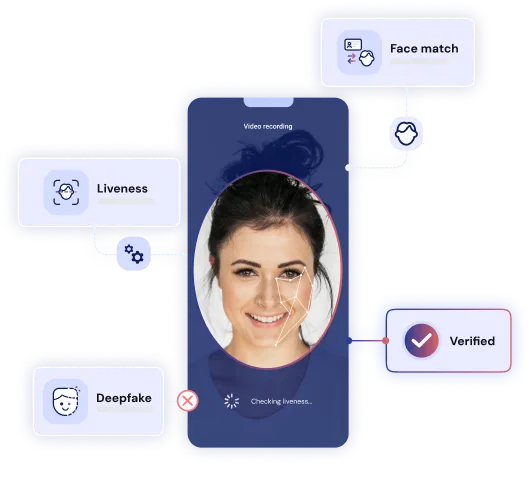
Why fraud teams pick this engine
Passive first, gesture second
Most checks run silently on texture and light. A brief zoom gesture is added because fixed-focus cameras cannot prove depth.
- No blink or head-turn drill
- Texture and light read silently
- 3D map from a 2D camera
Built for a GDPR review
Biometric data is a special category under GDPR. The controls are the product: your retention window, your deletion trigger.
- Deletion the moment a decision returns
- Retention window you configure
- A named Data Protection Officer
Three ways to embed it
Native SDKs for iOS and Android, a web widget, or the REST API behind your own screens. The checks are identical either way.
- iOS, Android and web SDKs
- Hosted flow needs no build
- The API route is two endpoints
What the engine checks
Passive liveness, depth capture and synthetic-media detection, checked against both presentation and injection attacks. Built in-house, running inside the EEA.
Facial matching
The portrait from the document or the chip compared with the live capture, as vectors not pixels.
Passive liveness
Skin texture, micro-expressions and light absorption read in the background, no drill to perform.
Depth capture
A brief zoom gesture builds a 3D map, because most selfie cameras cannot autofocus to prove depth.
Synthetic media
Face swaps, generated faces and frame-boundary artefacts flagged before a decision returns.
Injection attacks
The capture channel is encrypted end to end, so a video fed to the browser is not a video we accept.
Duplicate faces
One face against every prior verification, so a name change is not a new identity.
What the capture actually does
Open a secure channel
The capture stream is encrypted before the first frame, which is what closes the injection route.
- Encrypted before the first frame
- Injection route closed by design
- No unencrypted frame exists
Read the face passively
Texture, micro-expression and light-absorption checks run while the user simply holds the phone.
- No blink or head-turn drill
- Texture and light read passively
- Runs while the user just waits
Ask for one gesture
A short zoom in and out tracks facial keypoints against the background to build a depth map.
- One short zoom gesture
- Facial keypoints tracked
- A real depth map, not a guess
Write the evidence
The scores, the telemetry and the liveness video land in the audit trail, written once.
- Scores written to the trail
- Telemetry kept with the case
- Liveness video stored once
Questions before a demo
What are your FAR and FRR?
Active or passive liveness?
Do you store raw images or templates?
Does this help with BIPA?
How fast can engineering ship this?


Discover the future of identity verification
Book a demo or contact us — we'll show you how IDENTT fits your onboarding.
Book a call